

unBurnt Philosophy
We are living in a moment where chronic overload is colliding with constant uncertainty.
As a result, workplace stress and personal overwhelm has become a defining crisis of our time, affecting how companies perform, how leaders show up, and how women navigate work, caregiving, and identity.
Burnout isn’t a lack of resilience.
It’s what happens when capacity is exceeded for too long.
People don’t need fixing. Systems need redesign and people need support where the load actually lives.
That’s why our work spans three connected layers:
The workplace, where priorities, pace, and decision-making either protect capacity or quietly erode it
The individual, where stress shows up first as overload, emotional fatigue, and disconnection
The evidence, which informs everything we do, moving from data and theory to applied approaches that work in the real-world
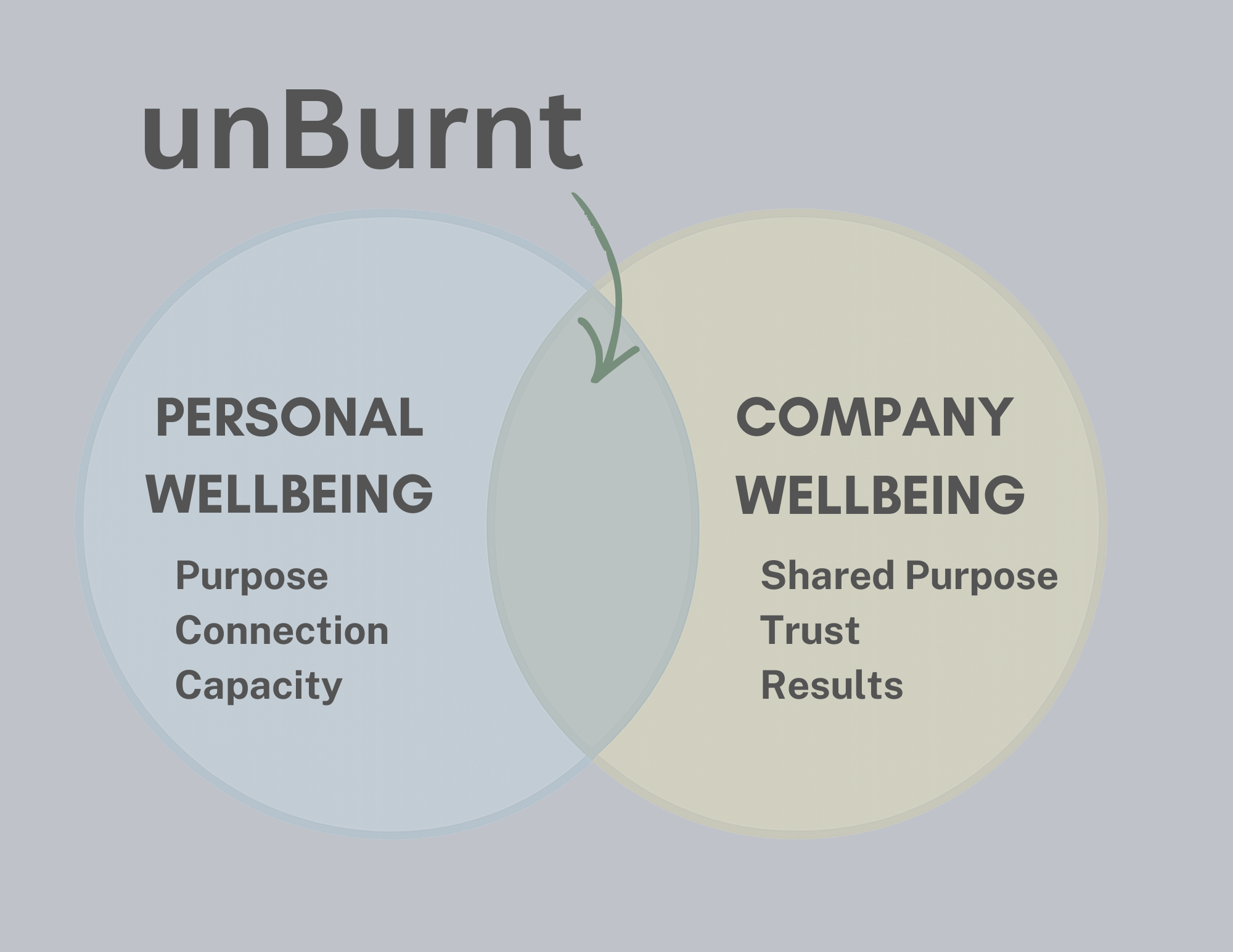
The Mission
To rebuild capacity & connection in a world that’s burning out.
unBurnt® is closing the widening gap between ambition and human energy by delivering:
Leadership training that is measurable and practical, with operational micro-shiftsthat fit real-world workplaces
Real-time stress navigation for professionals at the intersection of leadership and caregiving
Community spaces where together, we rebuild clarity, confidence, and capacity
The Backbone of the unBurnt® Ecosystem:
1. System Change: Reshaping the conditions that create overload
That means redesigning workflows and teams to address:
Too many competing priorities
Unclear expectations
Misalignment between strategy and execution
Meeting overload and digital noise
Lack of true recovery time
Cultures that reward constant grind over sustainable performance
2. Personal Capacity: Restoring what makes us human
When people are supported with practices that restore energy, wellbeing and performance is unlocked , including clarity, creativity, and better decision-making.
Movement
Reflection
Pause and Recovery time
Integrating and thinking about new ideas
Connection time with family and passions


Founder story

Alison Campbell | Founder & CEO, unBurnt | Connect on LinkedIn
Certified Health & Wellness Coach
After 20 years of climbing the corporate ladder in industries like Finance, E-commerce, and HRTech, and most recently as Chief of Staff at a $1B global company, I reached a breaking point.
Despite reaching an executive role and a coveted seat at the table, I was deeply burnt out, disconnected from joy, and found myself questioning if this was really “it”?
But after months of feeling unwell, a trip to the ER and surgery was the wake up to finally stop and question: what if constant overwhelm and chronic exhaustion isn't a personal failure, but instead a symptom of a systemic breakdown?
We’ve normalized hustle culture and accepted exhaustion as the price of entry.
Even with the best routines, wellbeing is jeopardized if the system doesn't support it. We need to stop masking the symptoms with perks and apps we don’t even have time to use, and remove the actual drivers of burnout at the source.
With a deep understanding of the challenges faced by professionals in fast-moving organizations, unBurnt® is blending evidence-based research with the realities of modern ways of working to help people and teams protect wellbeing and performance.
I fundamentally believe there are real opportunities to rearchitect the way we work to make space for more joy, better outcomes, and yes… less stress.